
Free to Grow: Why Optimizely Stopped Calling Itself a DXP (and Why Marketers Should Care)
A rebrand that is really a strategy memo
Here is a number that stopped me: 64% of B2B marketing leaders worry that mass AI adoption is creating a "sea of sameness." Only 31% say AI actually makes them feel free to do their best work.
Those figures come from a survey of 2,003 B2B marketing leaders that Optimizely commissioned from Savanta in May 2026. A month later, on June 22, Optimizely used them to launch something bigger than a new logo.
It stopped describing itself as a digital experience platform and started calling itself "the AI platform for marketing." Its new tagline: marketers should be free to grow.
In this first part of the series I want to unpack what that shift means. Not the colors and fonts, but the strategy underneath, and why it should change how you evaluate your own marketing stack in 2027 planning.

What Optimizely actually announced
Let's stick to the facts in the official release.
- A new positioning: Optimizely now presents itself as "the AI platform for marketing," bringing together content management, content marketing, experimentation, commerce, personalization and analytics.
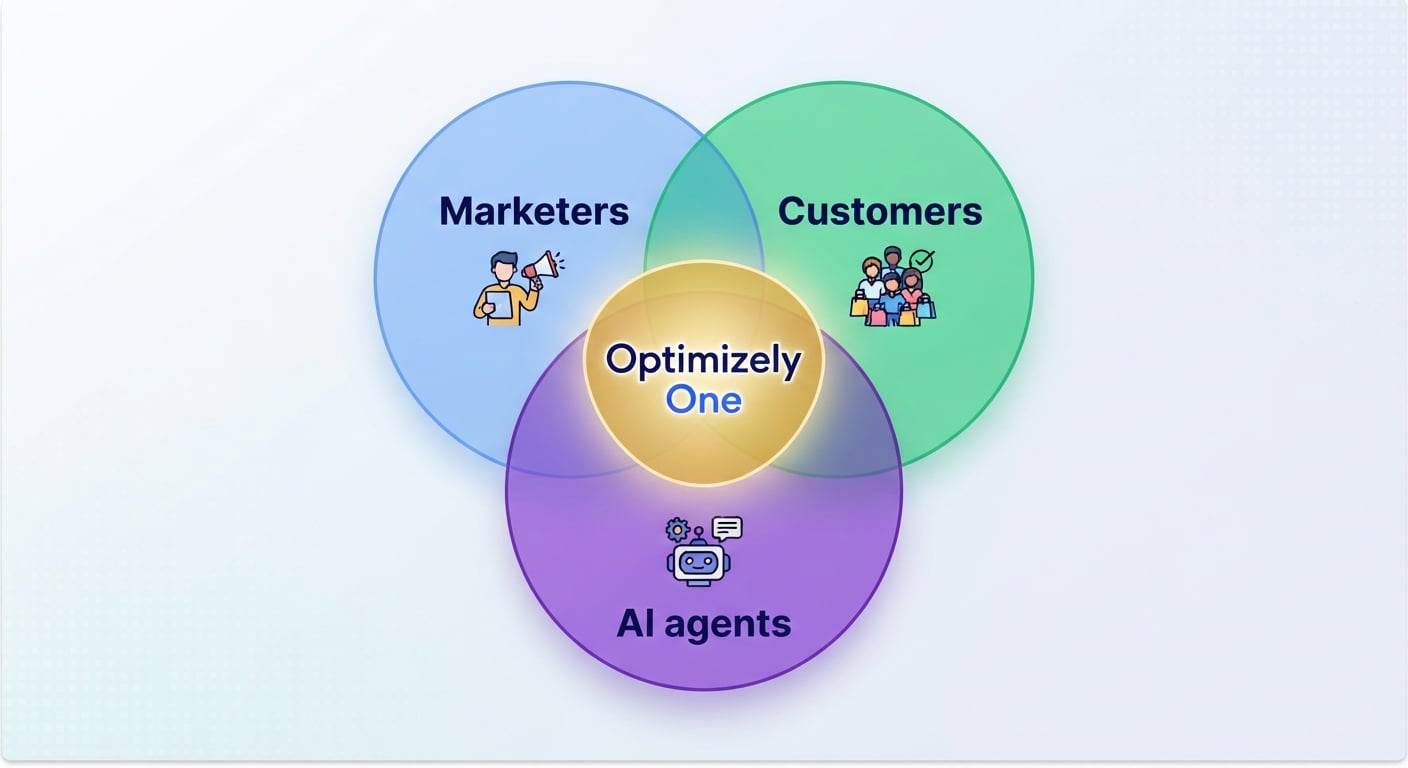
- Three audiences, not one: the platform is framed around marketers (freedom to create), customers (experiences they remember) and AI agents (the content they come looking for).
- A human-made brand: the identity was built with Ragged Edge and artist Andrey Kasay, with human-led creative direction and AI used for parts of production.
- A platform story behind it: the Optimizely Agent Platform connects foundational LLMs and AI agents to the experience layer where marketing work happens, with a "marketing harness" that stores brand context, workflows and experiment history.
CEO Alex Atzberger put it simply: "Our new brand is built around a simple belief: marketers should be free to grow."
Why drop the DXP label?
I have spent years helping teams choose and implement DXPs. The label always described the system: where content lives, how pages render, how data flows.
"AI platform for marketing" describes the work. That is a deliberate change in who the buyer is and what is being sold.
Three signals in the announcement explain the bet:
- Efficiency alone isn't enough. Optimizely's own framing is that AI has sped up content production but added complexity and left less time for strategy.
- Brand risk is real. 25% of surveyed leaders admit they regularly publish content they know is off-brand, because volume pressure beats the time needed to get it right.
- AI agents are now an audience. Naming agents as one of the platform's three audiences is a statement that your next visitor might not be a person. (Part 4 of this series goes deep on this.)
The proof points behind the pivot
A rebrand is only credible if the product already backs it. A few weeks before the new brand, Optimizely shared adoption data for Opal, the agent platform now called Mark:
- About 1,700 organizations use it across the marketing lifecycle.
- Customers have built more than 4,000 unique agents, and customer-built agents account for over 97% of activity.
- Opal ARR grew 42% quarter over quarter.
- Pairing the Content Marketing Platform with Opal increased campaign production by 85%, and Digital Asset Management reuse rose an additional 57%.
The same month, two launches showed where the platform was heading:
- June 10: a full AEO platform, with Agent Visibility Analytics and a partnership with Conductor, to measure how brands show up in AI answers.
- June 15: Limitless 1:1 Personalization, which uses agents to build, govern and keep updating a page for every target account or segment.
A real customer voice helps here. Mark Fagiano, Associate Vice President of eCommerce at Road Scholar, said adoption "happened faster than we expected because the value was clear right away."
The honest strategist's take
I like this pivot, but I don't think it is free of risk.
What is strong:
- It names the real problem. Most teams don't lack AI tools; they lack time, focus and brand consistency.
- It connects AI to the systems where results are measured: content, experimentation, personalization, commerce and analytics in one platform.
- It treats agents as a channel, which most stacks still ignore.
What to watch:
- Positioning moves faster than operating models. An "AI platform" doesn't help if your governance, data and approval flows are still built for 2019.
- Existing CMS and Commerce customers will need a clear path from what they run today to the agentic layer.
- "Free to grow" is a promise. Ask for proof in your own metrics: hours saved, campaign velocity, conversion lift.
What this means for marketing teams
If you run marketing or digital on Optimizely, or are evaluating it, here is where I would start:
- Audit your sameness. Pull ten recent AI-assisted assets and ask: could a competitor have published this? If yes, your brand context isn't in the loop.
- Map hours, not tools. List the recurring admin tasks your team does every week. Those are the first candidates for agents.
- Write down your brand context. Voice, claims, proof points, compliance rules. Whatever platform you choose, AI is only as on-brand as the context you give it.
- Add AI agents to your audience list. Start tracking how AI assistants describe your brand and which pages they read.
- Ask your vendor for the roadmap. Which capabilities are GA, beta or planned? Plan budgets on GA.
Conclusion
Optimizely's June rebrand is not cosmetics. It is a public commitment to move from managing digital experiences to running marketing work with AI, for three audiences at once: marketers, customers and agents.
The data behind it is uncomfortable and familiar: most marketers feel AI made them faster, not freer. The question for every marketing leader is whether their platform gives time back for strategy and creativity, or just produces more of the same.
What do you think: is "DXP" still the right way to describe your stack, or has the job changed? Tell me in the comments.
If this was useful, subscribe to The Marketers Lab so you don't miss the rest of the series, and share it with the person on your team who owns your martech roadmap.
Next up, Part 2: Optimizely's Virtual Teammates. What happens to the marketing org chart when your newest hire is an AI with its own identity, permissions and memory?
References
- Optimizely Unveils New Brand Identity Rooted in a Simple Belief: Marketers Should Be Free to Grow · Optimizely press release · June 22, 2026 · New positioning, Ragged Edge and Andrey Kasay, Atzberger and Tara Corey quotes, Savanta survey of 2,003 B2B marketing leaders (64%, 31%, 25%), three audiences, marketing harness.
- Optimizely Reports 42% Quarter-Over-Quarter ARR Growth for Its AI Agent Orchestration Platform · Optimizely press release · May 20, 2026 · ~1,700 organizations, 4,000+ agents, 97% customer-built, 42% QoQ ARR, +85% campaign production, +57% DAM reuse, Road Scholar quote.
- Optimizely Launches Full AEO Platform to Help Marketers Understand and Act on AI-Driven Content Discovery · Optimizely via PR Newswire · June 10, 2026 · AEO platform, Agent Visibility Analytics, Conductor partnership.
- Optimizely Solves Marketing's Biggest Broken Promise: True 1:1 Personalization at Scale · Optimizely press release · June 15, 2026 · Limitless 1:1 Personalization launch.
- Okay, who the eff is Mark? · Optimizely Field Notes · October 28, 2026 · Opal renamed Mark (Optimizely Agent Platform).
Leonardo Bravo
DevOps and IT Director at Oshyn | Experienced technology leader and former university professor
With over 20 years of experience in the technology, software, and IT sectors, I currently serve as the DevOps and IT Director at Oshyn, a digital solutions company that partners with some of the world's top brands and creative agencies to deliver exceptional digital marketing solutions. Additionally, I bring experience from academia, having taught at various universities, where I shared knowledge and inspired future professionals. I am dedicated to continuous learning, technological excellence, and creating value through strategic thinking, agility, and innovation.
Comments