
Linus Ekström
Apr 16, 2013
  4407
(0 votes)

Sending settings from the server to your editor

I got a question how you can send settings that are defined on the server to an editor. It’s really quite simple so lets have a look on a simple example. We start by defining an editor descriptor and adding an entry in the EditorConfiguration dictionary:

[EditorDescriptorRegistration(TargetType = typeof(string), UIHint = "author")]
public class AuthorEditorDescriptor : EditorDescriptor
{
    public AuthorEditorDescriptor()
    {
        ClientEditingClass = "alloy.editors.AuthorSelector";
        EditorConfiguration["foo"] = "bar";
    }
}

The settings in the EditorConfiguration dictionary is mixed on to the editor instance when started so you can access these settings as they were regular properties of your editor. This sample checks the value of foo in the postCreate-method:

postCreate: function () {


    if (this.foo === "bar") {
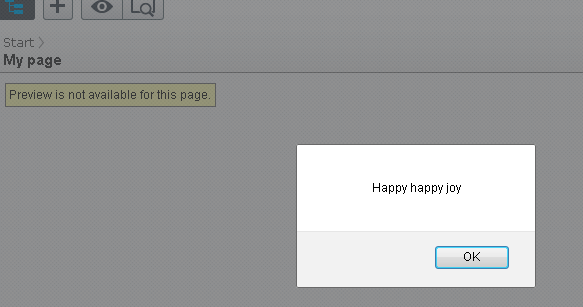
        alert("Happy happy joy");
    }
},

And when the editor starts we get:
image

Apr 16, 2013

Comments

Please login to comment.
Latest blogs
Creating an admin tool - unused assets

Let's make an admin tool to clean unused assets and see how to extend your favorite CMS with custom tools and menues! We will build a tool step by...

Daniel Ovaska | Apr 15, 2026

Running Optimizely CMS on .NET 11 Preview

Learn how to run Optimizely CMS on the .NET 11 preview with a single-line change. Explore performance gains, PGO improvements, and future-proofing...

Stuart | Apr 15, 2026 |

Your Optimizely Opal Is Probably Burning Carbon It Doesn't Need To

Four patterns Optimizely practitioners could be getting wrong with Opal agents: inference levels, oversized tool responses, missing output...

Andy Blyth | Apr 15, 2026 |

Optimizely CMS 13: A Strategic Reset for Content, AI, and Composable Marketing

Optimizely CMS 13 is not just another version upgrade—it represents a deliberate shift toward a connected, AI-enabled, and API-driven content...

Augusto Davalos | Apr 14, 2026