
Alex Wang
Optimizely
Alex Wang  -  CMS
Sep 10, 2018
visibility 5269
star star star star star
(8 votes)

Four-eyes content approval

The four-eyes principle means that a certain activity, i.e. a decision, transaction, etc., cannot be approved by the person making the change. This controlling mechanism is used to facilitate delegation of authority and increase transparency.

In previous Episerver versions, an editor who is also set as a reviewer can approve own changes. The four-eyes principle ensures that editors cannot approve their own changes. This feature was released in CMS UI 11.8.

Enabling four-eyes content approval

In the approval sequence settings, simply select the checkbox labeled "Prevent users from approving their own changes" to enable the four-eyes principle.
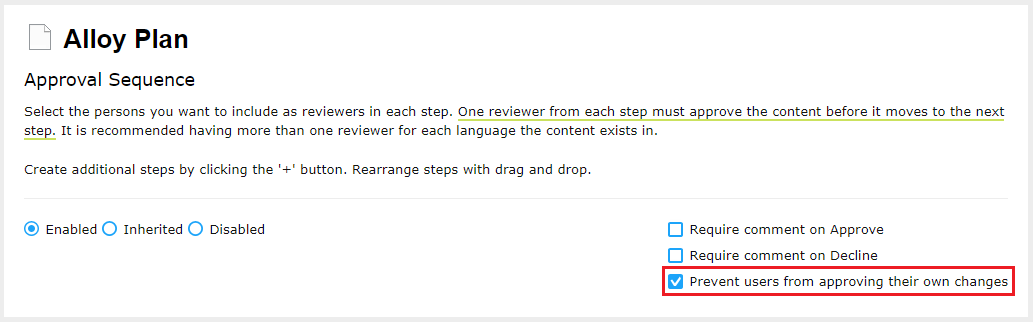
Image 4eyes.png

Sep 10, 2018

Comments

error Please login to comment.
Latest blogs
Surviving a Dirty Feed. Part 3: Error Handling and Event Batching

Committing a 250,000-row Optimizely catalog import row by row, returning a per-row failure report, and coalescing catalog events into one per batch.

Stanisław Szołkowski | Oct 16, 2026 |

Building UI Extensions for Optimizely SaaS CMS

Introduction Developers have been extending the functionality of Optimizely PaaS CMS for years using addons built in C# and deployed as NuGet...

Mark Stott | Oct 15, 2026

Cheapskate AI Translator: Because Translation Should Not Require a Second Mortgage

There is a particular kind of software project that begins with a detailed architecture document, a product roadmap, and a carefully assembled...

Linh Doan Cuu | Oct 15, 2026

Computed Fields in CMS 13 Content Contracts with Optimizely Graph

Content Contracts in Optimizely CMS 13 allow different content types to share a common structure when querying Optimizely Graph. But what if the...

Mardy | Oct 14, 2026