


Fixing “Published By” After OKTA SSO in Optimizely CMS
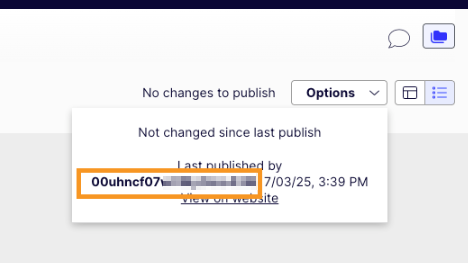
Enabling Okta SSO significantly strengthened our authentication and security model in Optimizely CMS. However, like many real-world implementations, it also introduced an unexpected challenge in the CMS authoring experience, as the system now stores the Okta ID as the username.
Problem:
After switching to SSO, we observed a change in how user identities were stored:
- The “Published By” field displayed Okta ID
- Instead of names or emails, editors saw technical IDs
Impact on Editorial Exp.
This created friction for content teams:
- Author attribution became unclear
- Content review was harder to follow
- Auditing lost its human-readable context
For non-technical users, this was a noticeable drop in usability.
Solution:
To address this, we introduced a custom transformation:
👉 PublishedByTransform
This transform maps the stored Okta identifier to a friendly display value, such as:
- Author name
- Email address
- Or any readable identity field
Instead of exposing raw Okta IDs, the CMS now resolves and displays meaningful user information.
 [ServiceConfiguration(typeof(IModelTransform), Lifecycle = ServiceInstanceScope.Singleton)]
 public class PublishedByTransform : ContentDataStoreModelTransform
 {
     private readonly EPiServer.Logging.ILogger _logger;
     private readonly IUserService _userService;
     private readonly IPrincipalAccessor _principalAccessor;
     private readonly IContentVersionRepository _contentVersionRepository;

     public PublishedByTransform(
         IUserService userService,
         IPrincipalAccessor principalAccessor,
         IContentVersionRepository contentVersionRepository)
     {
         _userService = userService ?? throw new ArgumentNullException(nameof(userService));
         _principalAccessor = principalAccessor ?? throw new ArgumentNullException(nameof(principalAccessor));
         _contentVersionRepository = contentVersionRepository ?? throw new ArgumentNullException(nameof(contentVersionRepository));
         _logger = LogManager.GetLogger(typeof(PublishedByTransform));
     }

     public override void TransformInstance(IContent source, ContentDataStoreModel target, IModelTransformContext context)
     {
         base.TransformInstance(source, target, context);
         ContentVersion contentVersion1 = this._contentVersionRepository.Load(source.ContentLink);
         ContentVersion contentVersion2 = _contentVersionRepository.LoadPublished(source.ContentLink, source.LanguageBranch());

         if (contentVersion1 != null)
         {
             var versionCreatedBy = string.IsNullOrEmpty(contentVersion1.StatusChangedBy) ? contentVersion1.SavedBy : contentVersion1.StatusChangedBy;
             target.VersionCreatedBy = ResolvePublishedBy(versionCreatedBy);
         }

         if (contentVersion2 != null)
         {
             var publishedBy = !string.IsNullOrWhiteSpace(contentVersion2.StatusChangedBy)
                 ? contentVersion2.StatusChangedBy
                 : contentVersion2.SavedBy;

             target.PublishedBy = ResolvePublishedBy(publishedBy);
         }
     }

     private string? ResolvePublishedBy(string? publishedBy)
     {
         if (string.IsNullOrWhiteSpace(publishedBy))
             return publishedBy;

         try
         {
             var user = _userService.GetUserByName(publishedBy);
             if (user == null)
                 return publishedBy;

             var claimsPrincipal = _principalAccessor.Principal as ClaimsPrincipal;
             var currentUserEmail = claimsPrincipal?.FindFirst("email")?.Value ?? claimsPrincipal?.FindFirst(ClaimTypes.Email)?.Value;
             if (!string.IsNullOrWhiteSpace(currentUserEmail)
                 && !string.IsNullOrWhiteSpace(user.Email)
                 && string.Equals(currentUserEmail, user.Email, StringComparison.OrdinalIgnoreCase))
             {
                 return "you";
             }

             return !string.IsNullOrWhiteSpace(user.Email) ? user.Email : user.UserName;
         }
         catch (Exception ex)
         {
             _logger.Error($"PublishedByTransform failed to resolve PublishedBy for value '{publishedBy}'. Error: {ex}");
             return publishedBy;
         }
     }
 }
Result:
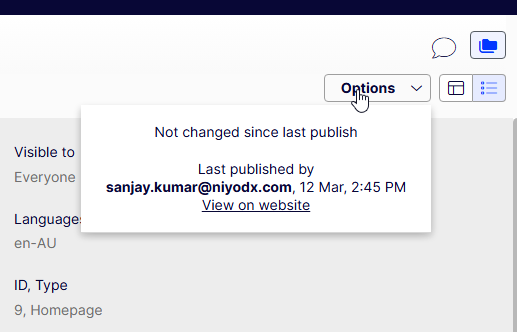
With this small but impactful enhancement, we achieved the best of both worlds:
- Secure SSO via Okta remains fully in place
- “Published By” now shows clear, readable author names
Thank you for reading the blog. Cheers!
Thanks for sharing.